
Our Pittsburgh House Sit: A 200-Pound Dog, a Cockatoo, and a Plumbing Problem
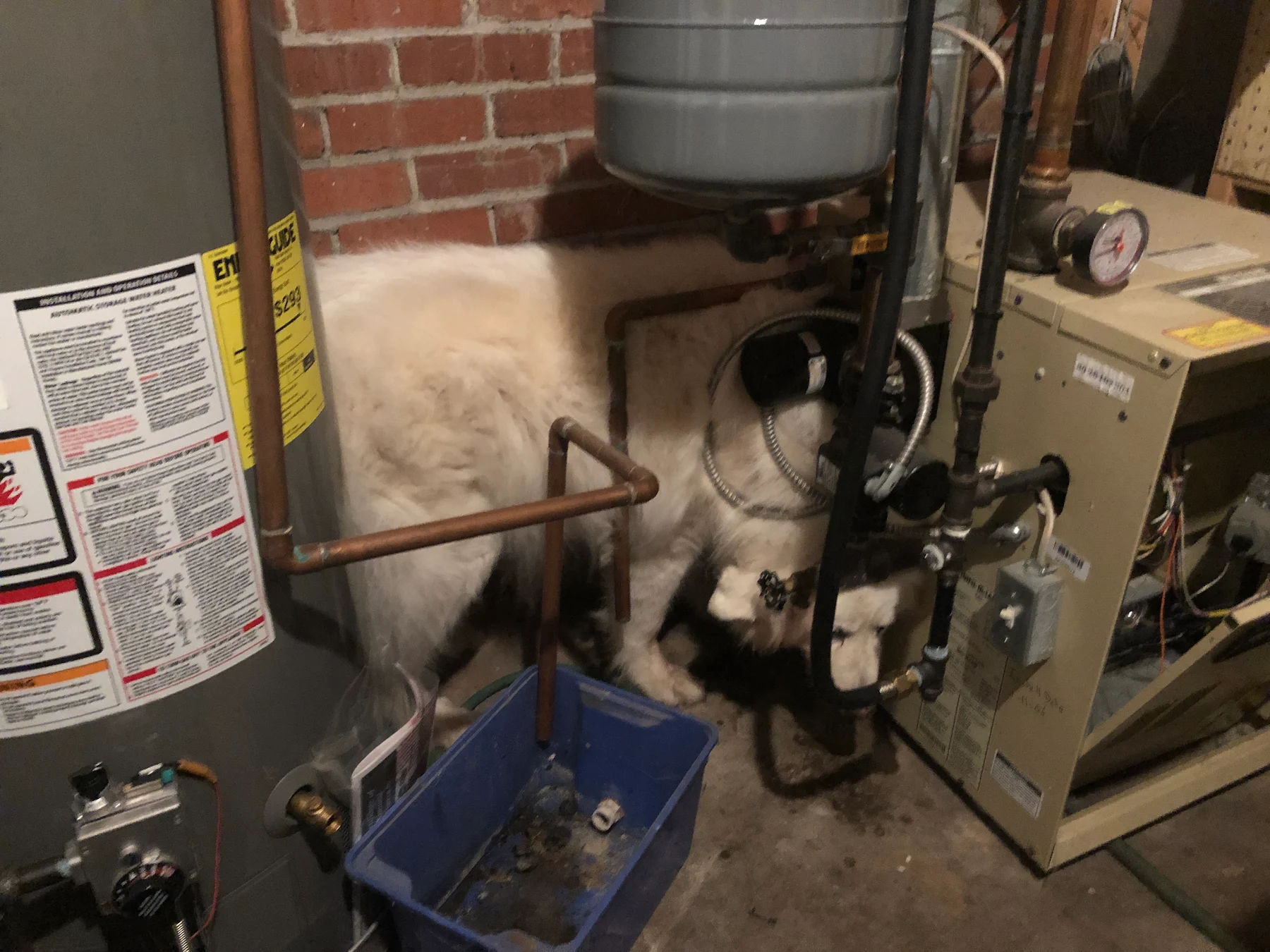
Somewhere in a basement outside Pittsburgh, Pennsylvania, I found myself moving a very heavy recliner into position against a couch, trying to prevent a 200-pound Great Pyrenees from breaking into a utility closet.
I’d already removed a section of plumbing to rescue him from that same closet.
And the homeowners had described him as being “a little scared of thunderstorms.”
A little.
We were learning that house-sitting descriptions sometimes needed considerably more explanation.
If You Can Handle Horses, You Can Handle Anything. Right?
When Linda and I started traveling full time in May 2019, house sitting was a major part of our plan. We’d sold most of our possessions, packed what remained into a Chevy Sonic, and started moving from one house sit to another.
Our first sits had been on horse farms in the South, and they were wonderful. Beautiful homes surrounded by acres of pasture, magnificent horses wandering around, and mornings spent drinking coffee while watching them from the property.
I discovered that I was something of a horse whisperer.
Naturally.
We even established our first official rule of house sitting:
If you can handle horses, you can handle any pet.
We were quite pleased with that bit of wisdom.
Then we went to Pittsburgh.
Pittsburgh hadn’t been on our bucket list. We were traveling west, needed somewhere to stay along the way, and found a house sit that worked with our schedule.
The city turned out to be wonderful.
The house?
Well, that’s a different story.
The Other Pittsburgh Zoo
We actually visited the Pittsburgh Zoo during our stay. But we had a pretty interesting collection of animals waiting for us back at the house, too.
The property looked charming from the driveway. Quaint country house. Moss-covered roof. The sort of place that makes you think you’ve found another excellent stop on your house-sitting adventure.
Then we went inside.
Our responsibilities included a young Springer Spaniel with an apparently unlimited supply of energy, a cat who had never heard of personal boundaries, a cockatoo, a bearded dragon, and a 200-pound Great Pyrenees with some serious issues.
Overnight, Linda and I had become Dr. and Dr. Doolittle.
The bearded dragon appeared to be the most emotionally stable member of the household.
The house was covered in animal fur. Everywhere. The cockatoo was allowed to fly freely around the house, leaving little gifts on the living-room floor. The cat considered the kitchen counter perfectly acceptable real estate, including the area immediately surrounding the frying pan.
And then there was the bird.
The homeowner fed her cereal from his own spoon.
The SAME spoon.
Now, we love animals. We’ve taken care of horses, dogs, cats, and all sorts of creatures during our travels. But there’s a difference between loving your pets and sharing your breakfast utensils with them.
Apparently, we had different definitions of that particular boundary.
There was no way we were unpacking our belongings until we’d cleaned the house. So that’s exactly what we did.
Four hours of cleaning.
Before we unpacked a single thing.
The animals watched us as though we’d arrived to dismantle their entire civilization.
And we hadn’t even gotten to the really interesting part.
He’s Just a Little Scared of Storms
Before the homeowners left, they mentioned something about the Great Pyrenees.
We’ll call him Samson, because we’re changing names to protect the not-so-innocent.
Samson, they explained, was a little scared of thunderstorms. If a storm came through, he might try to hide somewhere.
Okay. Dogs get scared during storms. We understood that.
What we didn’t understand was that Samson had a very specific destination in mind, and absolutely nothing was going to keep him from reaching it.
One night, a thunderstorm rolled through.
Samson started scraping at the floor near the foot of our bed. There was already evidence that this was his preferred excavation site, although someone had thoughtfully covered the damage with a throw rug.
Eventually, things got quiet.
We went to sleep.
And when we woke up, Samson was gone.
Now, losing a small dog inside a house is one thing. Losing a 200-pound Great Pyrenees is an entirely different accomplishment.
But Samson had vanished.
He’d pushed through two baby gates and made his way downstairs. We eventually discovered him in the basement, wedged behind the air-conditioning unit in a utility closet.
Somehow, this enormous animal had squeezed himself between the air conditioner and the water heater, into a space that appeared barely large enough for a Shih Tzu.
And the closet door had closed behind him.
Getting him out required a little ingenuity.
And plumbing.
I had to remove a section of pipe to create enough space for Samson to escape.
“A little scared of storms.”
Right.
The Battle of the Basement
We needed a way to keep Samson out of that utility closet during the next storm.
Our first attempt involved putting a couch across the closet door.
Samson moved it.
We added more furniture.
Samson wasn’t impressed.
Eventually, I wedged a very heavy recliner between the walls and the couch, creating a barricade that finally held.
There were now two extremely stubborn creatures in that basement. One was a 200-pound dog determined to get into his storm bunker. The other was a former Marine equally determined to keep him out.
Neither one intended to lose.
Samson didn’t care about the baby gates, the furniture, the plumbing, or the fact that the space he wanted to occupy was completely unsuitable for an animal his size.
He wanted into that closet.
I wanted him to stay out.
And somewhere along the way, our house sit had turned into a home-improvement project.
This was not exactly what we’d pictured when we signed up for house sitting.
Coco, My Very Affectionate Girlfriend
And then there was Coco.
Coco was a cockatoo. Bigger, louder, and stronger than a cockatiel, with a beak capable of making her displeasure painfully clear.
She decided I was her vacation boyfriend.
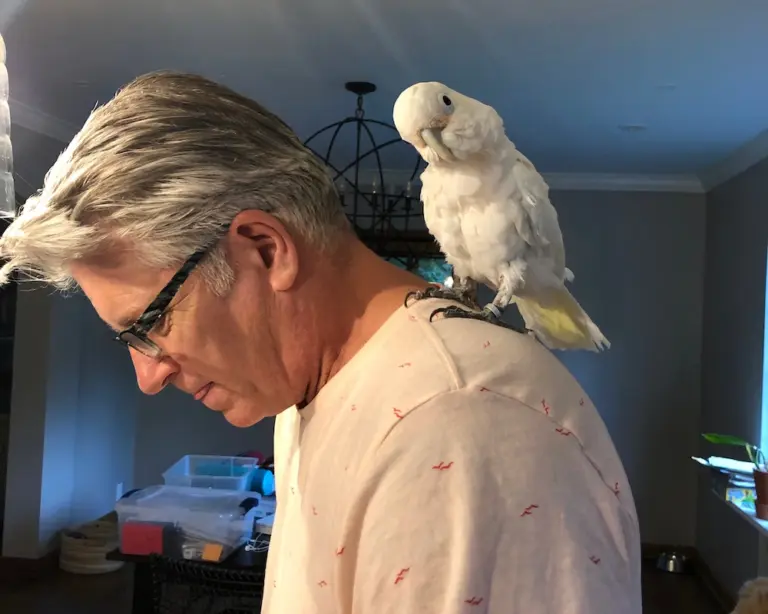
Unfortunately, she was a very demanding girlfriend.
Every evening, when Linda and I settled down to watch television, Coco would fly over and land beside me. She wanted attention. Specifically, she wanted to be petted.
Continuously.
As long as I kept petting her, everything was wonderful. But the moment I stopped, she expressed her disappointment by biting whatever part of me happened to be closest.
My hand. My shoulder. My ear.
Dealer’s choice.
I’ve been loved less aggressively by actual people.
The problem wasn’t that Coco didn’t like me. It was that she liked me WAY too much.
Between Samson’s basement adventures and Coco’s aggressive affection, I was beginning to think our horse-whispering credentials might not be as transferable as we’d believed.
We Were Already Good House Sitters. We Needed to Become Better Choosers.
Here’s the important part of the Pittsburgh story.
We didn’t leave Pittsburgh needing to become better house sitters.
We were already good house sitters.
We knew how to take care of animals, respect someone else’s home, follow instructions, and handle the responsibilities that came with a sit.
We’d already done all of that successfully.
And Pittsburgh certainly didn’t change our ability to handle unexpected situations. We’d cleaned the house, cared for the animals, rescued Samson, and figured out how to keep him safe during storms.
What Pittsburgh exposed wasn’t a problem with how we cared for a house.
It was a problem with how we chose one.
We’d looked at the location, the dates, the home, and the basic responsibilities. We knew there were animals to care for.
What we didn’t fully understand was what everyday life inside that house would actually be like.
How clean was the home? What were the animals allowed to do? How did they behave when their owners were away? What happened during thunderstorms? Were there unusual routines or behaviors that could make the stay considerably more complicated?
We weren’t asking enough of the right questions before we agreed.
And that was something we could change.
So we changed how we evaluated house sits. We became more careful about the listings we considered, more curious about the details, and more deliberate about the conversations we had with homeowners.
Pittsburgh didn’t make us better house sitters. It made us better house-sit choosers.
And there’s a big difference.
What We’d Tell You Before Accepting a House Sit
We still believe house sitting can be a terrific way to travel. It has allowed us to stay in places we might never have visited, spend less on lodging, and experience destinations in a way that hotels rarely provide.
But Pittsburgh taught us that a beautiful location and a convenient set of dates aren’t enough. Before agreeing to care for someone else’s home and animals, there are a few things we’d encourage you to find out.
Ask about the animals’ actual behavior. “A little scared of storms” doesn’t tell you much. Does the dog hide under the bed, bark for an hour, damage things, or squeeze into places where somebody will need a plumbing wrench to rescue him?
Understand the house rules. Are animals allowed on furniture, kitchen counters, or beds? Do birds fly freely throughout the house? What is the normal cleaning routine? You need to know what you’re agreeing to live with.
Pay attention to what homeowners say about cleanliness. When a listing says, “We expect the house to be as clean as when we left it,” chances are the homeowners keep a clean house themselves. It’s not a guarantee, but it’s the kind of detail we’ve learned to notice.
Don’t rely entirely on attractive photographs. Ask enough questions to understand what the house is like day to day. A video conversation or walkthrough can help you see more than the listing photos reveal.
Ask about special needs and difficult situations. Storm anxiety, escape attempts, unusual feeding routines, behavioral problems, and emergency procedures are all worth discussing before accepting the responsibility.
Know what you’re comfortable handling. You can love animals and still decide that a particular combination of pets, behaviors, and household expectations isn’t right for you. It’s better to say no beforehand than regret saying yes after arriving.
Trust the conversation, not just the listing. The best house sits begin with clear expectations on both sides. If you don’t understand something, ask. And if the explanation raises more questions, keep asking.
Most importantly, remember that you’re accepting responsibility for somebody else’s home and animals. The lodging may not cost you anything per night, but you’re still making a commitment.
Make sure you understand that commitment before saying yes.
Pittsburgh Was a Great City. The House Sit Was Another Matter.
We didn’t leave Pittsburgh thinking house sitting was a terrible idea.
But let’s be clear about something.
Of all the house sits we’ve done, Pittsburgh was the worst.
Not the worst city. Not the worst travel experience. The worst house sit.
And that matters, because we’d already had some wonderful experiences, and we went on to have many more. Pittsburgh was the exception, not the rule.
For one thing, we didn’t exactly have a home to go back to. We’d packed our whole life into a car and left. We’d committed to traveling full time, and house sitting was one of the ways we made that lifestyle possible.
More importantly, we knew from experience that house sitting worked. This particular arrangement just wasn’t one we’d ever choose again.
Our travels continued through the United States and eventually took us to places like Hawaii, the Caribbean, and Europe. House sitting remained an important part of how we traveled.
But after Pittsburgh, we read listings differently.
We paid attention to details we’d previously overlooked, especially the expectations homeowners put in writing. A sentence about leaving a home as clean as we found it might seem insignificant. But to us, it suggested that cleanliness mattered to the people who lived there.
That was useful information.
We asked more questions. We paid closer attention to the answers. And we stopped assuming that because we’d successfully cared for horses, every other animal would be easy.
The point wasn’t to become suspicious of every homeowner or avoid animals with special needs. It was to understand exactly what we were agreeing to before we showed up with our suitcases.
Some lessons come from wonderful experiences.
Others come from dismantling plumbing to rescue a dog the size of a loveseat.
And occasionally, from a cockatoo who believes affection should be a full-time occupation.
Would we go back to Pittsburgh?
Absolutely.
Would we accept that same house sit again?
Not a chance.
Being a good house sitter means taking excellent care of the home and animals entrusted to you. Being a good house-sit chooser means knowing which responsibilities you’re willing to accept in the first place.
Pittsburgh taught us the second one.
There’s Another Side to Our Pittsburgh Story
Now, before you think Pittsburgh was nothing but a giant dog, a possessive cockatoo, and four hours of cleaning, there’s something else you should know.
We really liked Pittsburgh.
And there’s a whole lot more to the city than football and steel.
We explored beyond the house, including one of Pittsburgh’s hillside inclines, a distillery making vodka from potatoes, Primanti Bros., and the actual Pittsburgh Zoo.
We’ve got plenty of photographs and stories from that visit that we haven’t shared yet.
So Pittsburgh deserves another article, one about the city rather than the animals we were responsible for.
That story is coming.
And I promise it won’t require a plumbing wrench.
Want to See Why We Kept House Sitting?
If Pittsburgh has you wondering why anyone would voluntarily stay in somebody else’s house and take care of their animals, we understand.
But this wasn’t our normal experience. House sitting has allowed us to spend more time in wonderful places, save money on lodging, and explore destinations we might otherwise have missed.
If you’re curious about how the arrangement works, start with our House Sitting 101 guide. We explain the responsibilities, the costs, and the questions worth asking before accepting your first sit.
And for a different side of house sitting, read Aruba Beyond the Beaches. Our house sit put us inland, away from the resorts, and gave us the freedom to explore an Aruba we hadn’t expected to find.
That’s much closer to what made house sitting worth doing for us.
Although, after Pittsburgh, a house sit where nothing particularly remarkable happens sounds pretty wonderful, too.
Thanks for coming along for the ride.
With love and laughter,
Matt & Linda
More house-sitting stories and practical tips? Explore our House Sitting Hub →